Earn your place at the top (of the inbox)
BFCM puts more pressure than ever on your sender reputation. You’re sending more often, reaching larger audiences, and competing with a surge of other brands for your subscribers’ fleeting attention. Meanwhile, inbox providers like Microsoft, Google, Apple, and Yahoo closely monitor your sending behavior and use increasingly sophisticated technology to raise the bar for inbox placement. It’s a lot to manage!
What you do before peak season can make or break your biggest BFCM sends, and the revenue riding on them.
Watch the video below for 4 ways to strengthen your deliverability, protect your sender reputation, and give your BFCM campaigns a fighting chance at getting seen.
Use the strategies below to clean up your audience, build sending volume safely, strengthen your inbox signals, and spot trouble before your biggest BFCM sends.
1. Cut the dead weight
BFCM isn’t the time to take chances with an unhealthy list. In September, start by identifying profiles that can hurt your sender reputation, including invalid addresses, hard bounces, junk contacts, and subscribers who have never engaged. Then suppress them from your list.
For profiles who have engaged but may have been inactive for a year or more, give them 1 last chance to stay subscribed with a re-engagement campaign or a sunset flow. If they still don’t engage, suppress them before your BFCM volume ramps up.
Prioritize quality over quantity.
Focus your BFCM sends on people who actually engage with your emails. Oftentimes, smaller engaged segments outperform a bloated list full of profiles who never open, click, or buy.
2. Send the right signals
Cleaning your list is only part of the equation. Engagement, spam complaints, bounces, and unsubscribes all play a role in whether inbox providers deliver your messages to the inbox, but so does how you set up and structure your emails. And as artificial intelligence becomes more influential, it adds yet another audience to consider: Inbox AI.
Inbox AI is evolving functionality that can summarize, prioritize, and surface information from your emails before a customer even opens them. That gives brands one more reason to make every message clear, focused, and easy to interpret.
Explore the tabbed gallery below to learn how to send clear signals to inbox providers, AI, and your customers.
Authenticate your sending domain
Set up a branded sending domain so inbox providers can more easily verify that your emails are really coming from your brand.
This gives you more control over your sender reputation and helps you meet authentication requirements from major inbox providers.
Learn how to set up a branded sending domain and authenticate your emails before BFCM.
Check your reputation
Use third-party tools like Google Postmaster Tools to get another view of your sender reputation and deliverability.
If you send to a large number of Gmail users, Postmaster Tools can help you monitor secure delivery, successful delivery, and spam reports so you can spot potential issues early.
Explore third-party deliverability monitoring tools to learn what else you can monitor before BFCM.
Make your message crystal clear
Make it easy for customers and inbox technology to understand what you’re sending.
Clear, accessible content helps people engage with your message while making it easier for inbox providers to interpret and process your emails.
Use clear subject lines, focused content, and descriptive links, and follow accessibility and design best practices like adding alt text, using meaningful live text, and avoiding image-only emails.
Make opting out easy
Give customers a clear, simple way to unsubscribe when they no longer want to hear from you.
An easy-to-find unsubscribe link can reduce spam complaints, which have a greater negative impact on your sender reputation than unsubscribes.
Make your link easy to see and tap, honor communication preferences, and consider global unsubscribes so customers don’t continue receiving messages they thought they opted out of.
Learn more ways to reduce spam complaints and protect your sender reputation.
3. Ramp without raising red flags
For most brands, your BFCM sending volume likely won’t look anything like a normal week. You’ll probably send a lot more messages to a lot more people, going well beyond the typical sending patterns inbox providers are used to seeing from you.
If you jump up in volume too quickly, that sudden spike can raise red flags with inbox providers. They may throttle your sends, push more messages to spam, or block them altogether. That hurts your sender reputation and puts BFCM revenue at risk.
That’s why you need to build toward your peak volume gradually. Start with your most engaged subscribers, then layer in small groups of less-engaged profiles as performance allows. This gives inbox providers time to adjust to your higher volume while giving you time to spot and respond to problems along the way.
After your subscriber list has been cleaned, begin increasing your sending frequency and volume with your most engaged subscribers.
Try this: Add a campaign to your weekly cadence. For example, if you normally send twice a week, add a third campaign to your 30-day engaged segment. Make sure the content is relevant so they are more likely to find value in it.
Gradually bring segments of less-engaged subscribers into your sends as your volume grows.
Try this: If you typically send to subscribers engaged in the last 30 days, expand your next campaigns to include sample segments of profiles who engaged within 60 days, and then 90 days as performance allows. Be conservative with your volume, aiming to increase the total number of profiles per campaign by no more than 30% over your previous send.
Watch engagement and deliverability as you expand. If performance starts to slip, slow down before increasing volume again.
Try this: If spam complaints or bounce rates rise after expanding your audience, return to your more-engaged segment for the next send instead of expanding further.
Aim to reach your planned BFCM volume by the first week of November, leaving roughly two weeks to address any problems before peak sending.
Try this: By early November, send to an audience similar in size and engagement level to the one you expect to target during BFCM. Use the results as a final gut check before peak season.
4. Catch trouble before it costs you
Deliverability problems rarely show up all at once, and the warning signs often appear long before your reach starts to suffer.
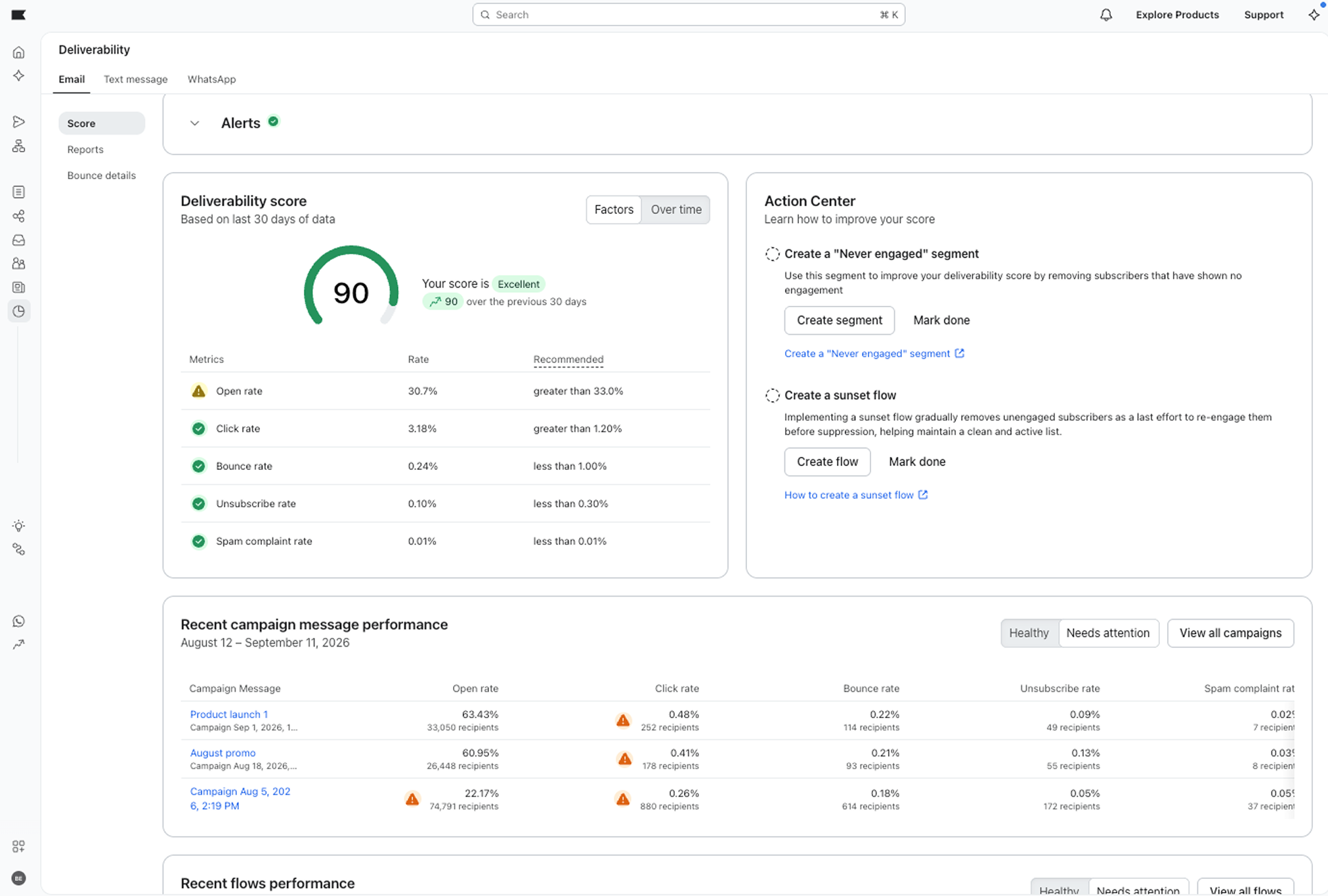
As you ramp up for BFCM, keep a close eye on your performance so you can catch small warning signs before they become expensive problems. Klaviyo’s Deliverability Hub gives you a centralized place to see how your sending is performing and where your reputation may need attention.
Important
Don’t wait until BFCM to repair your reputation. If your deliverability starts heading in the wrong direction, act early. Klaviyo’s automated reputation repair AI can help you recover, but it may limit your audience while active, so give yourself enough time to complete it before peak BFCM sends.
Are you ready for the inbox?
Before your BFCM volume kicks into high gear, give your plan one final gut check:
- Is your list clean?
- Are you sending inboxes the right signals?
- Have you ramped your sending?
- Do you know what to monitor?
If you can answer yes to all 4, you’re ready to fight through the BFCM noise and win your place in the inbox.